
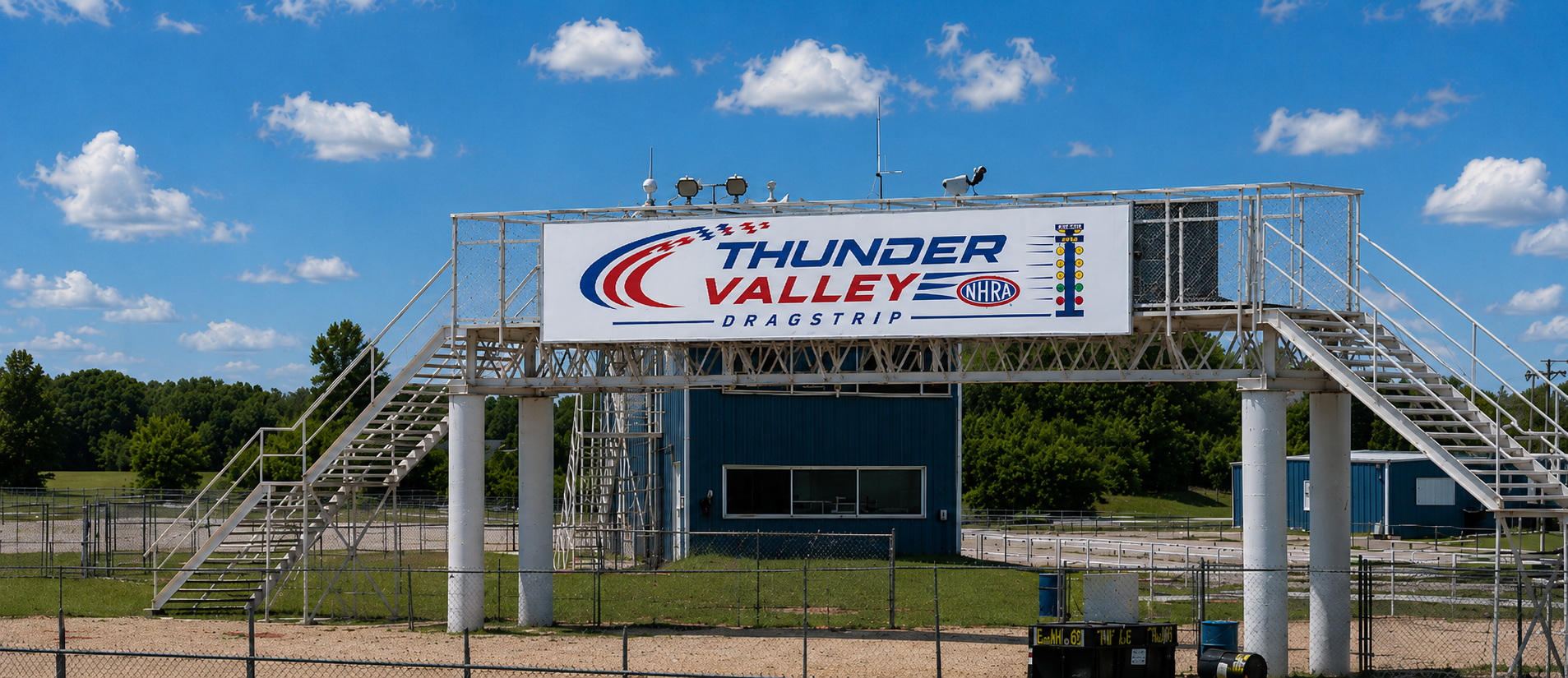
General Information, Rules, and FAQ’s
Everything you need before, during, and after your visit to Thunder Valley.
Facility Rules
-
Everyone at Thunder Valley Dragstrip is expected to treat others with respect and help keep the facility safe and enjoyable for all.
Anyone who threatens or harasses another person, uses abusive or offensive language, is excessively intoxicated or under the influence of drugs, brings a weapon onto the property, behaves in an unsafe or unsportsmanlike manner, or violates Thunder Valley Dragstrip or NHRA rules may be disqualified from the event, removed from the facility, or banned from future events. These decisions are made at the sole discretion of Thunder Valley Dragstrip management and staff.
-
Yes. Only approved media and track personnel may go beyond the starting line.
For more information on becoming a media partner, please send us a message!
-
For the safety of our guests, participants, and staff, the use of unmanned aerial vehicles (UAVs), commonly known as drones, is not permitted anywhere on Thunder Valley Motorsports Complex property without prior authorization from track management.
Anyone operating a drone without permission will be asked to stop immediately. If necessary, track personnel may require the drone to be grounded or held until the conclusion of the event.
-
Bag Checks & Prohibited Items
For the safety of our guests, participants, and staff, all bags, coolers, and personal items are subject to inspection upon entry.
Guests may be asked to return prohibited items to their vehicle or dispose of them before entering the facility.
Prohibited items include, but are not limited to:
Glass bottles or containers
Firearms, knives, or other weapons
Illegal drugs or drug paraphernalia
Fireworks or explosives
Personal grills or open-flame cooking equipment
Drones (unless authorized by track management)
Skateboards, roller skates, and inline skates
Large umbrellas or shade structures that obstruct the view of other guests
Any item deemed unsafe or disruptive by Thunder Valley Motorsports Complex staff
Thunder Valley Motorsports Complex reserves the right to refuse entry or remove any prohibited item from the facility to help ensure a safe and enjoyable experience for everyone.
-
You may bring food and drinks.
Outside alcoholic beverages and glass containers are not permitted anywhere on Thunder Valley Motorsports Complex property, including the parking areas. Guests leaving the facility with an alcoholic beverage will not be permitted to re-enter with it.
Guests are welcome to bring a cooler measuring 12" x 12" x 12" or smaller. Personal grills or open-flame cooking equipment, including propane and charcoal grills, are not permitted.
Coolers, backpacks, and other bags are subject to inspection upon entry and at any time while on the property.
Please help us keep Thunder Valley clean by placing all trash in the receptacles provided throughout the facility. Your cooperation helps create a safe, clean, and enjoyable experience for everyone.
-
We welcome well-behaved pets at most events! For the safety and comfort of all guests, pets must be kept on a leash and under their owner's control at all times.
Some events may have different pet policies due to sanctioning requirements or event-specific restrictions. If you're planning to bring your pet, we encourage you to contact us before your visit so we can let you know what to expect.
Service animals are welcome throughout the facility. Please note that emotional support animals and service animals in training are not considered service animals under applicable regulations.
-
We welcome race fans of all ages at Thunder Valley Motorsports Complex!
For everyone's safety, some areas of the facility are designated as restricted access. Guests must be at least 14 years old to enter these areas and must sign a liability waiver. Guests ages 14–17 must have a parent or legal guardian sign the waiver on their behalf.
-
We want everyone to have a comfortable and enjoyable race day experience. Please help us be considerate of those around you by following these guidelines:
Stadium seats and seat cushions are welcome, provided they fit within your assigned seating space and do not interfere with neighboring guests.
Stadium seats should be no larger than 18" wide by 10" deep, must sit flat on the bleacher, and may not have legs or supports.
Umbrellas and other shade devices are not permitted in the grandstands or attached to fences or other structures, as they can block the view of other guests.
General Admission seating is available on a first-come, first-served basis each event day. Seats may not be reserved overnight or from one day to the next.
Blankets or other items left behind after an event may be removed by staff during cleanup.
Thank you for helping us create a safe, comfortable, and enjoyable experience for everyone!
-
For the safety of our guests, the use of personal motorized or wheeled vehicles by General Admission attendees is not permitted on Thunder Valley Motorsports Complex property. This includes, but is not limited to:
ATVs and UTVs
Golf carts
Electric bicycles and scooters
Hoverboards and Segways
Mopeds and minibikes
Skateboards, roller skates, and inline skates
Bicycles
Participants may use approved vehicles within designated pit areas during authorized events, subject to event rules and track management approval.
Guests under the age of 16 may not operate any motorized vehicle on Thunder Valley Motorsports Complex property.
Motorized wheelchairs and other mobility devices used for accessibility are always welcome.
-
General Admission tickets and tech cards can be purchased using cash or credit/debit card.
General Admission FAQs
What Should I Bring?
1
When preparing for a day at the track, don’t forget the essentials! Bottled water, sunscreen, sunglasses, layers of clothing, bug spray, seat cushion, power bank, earplugs/earmuffs, and comfy shoes are some suggestions.
What is your Refund Policy?
2
All general admission ticket sales are final. Thunder Valley Dragstrip does not issue refunds for tickets purchased for scheduled events.
If an event is officially postponed or declared a rainout, your ticket will not go to waste. Depending on the event, your ticket may be honored on the rescheduled date or accepted as admission to another eligible Thunder Valley Dragstrip event within one year of the original event date. Please keep your ticket or proof of purchase, as it may be required for redemption.
If you have questions about a postponed or canceled event, we're happy to help. Please contact us directly for questions about specific events.
What Happens if an Event Is Rained Out?
3
Oklahoma weather can be unpredictable, and while we always do our best to complete each event, safety comes first.
If a Thunder Valley Dragstrip event is officially declared a rainout, your general admission ticket may be used at another eligible Thunder Valley event within one year of the original event date. Please keep your ticket, as it will be required for redemption. Some restrictions may apply.
If an event is postponed and rescheduled, your ticket will automatically be honored on the new event date. Refunds or vouchers will not be issued for rescheduled events.
Can I take Pictures / Videos
4
Yes, but only approved media personnel & track crew may go beyond the starting line.
How much do tickets cost?
5
General admission pricing varies by event. Check our schedule and select an event for details. SEE SCHEDULE
Glossary
A
Aftermarket
The market for replacement, upgraded, or high-performance parts that are not supplied as original equipment by the vehicle manufacturer.
Air Dam
An aerodynamic panel designed to direct or block airflow. A front air dam reduces the amount of air traveling underneath the vehicle, helping decrease turbulence and front-end lift.
Ambers
The three yellow lights on the Christmas Tree that illuminate before the green light. On a Sportsman Tree, they illuminate one at a time. On a Pro Tree, all three illuminate simultaneously.
Arm Restraints
Safety devices that restrict a driver’s arm movement and help keep the arms inside an open-cockpit vehicle during an accident.
Auto Start
A timing-system feature that automatically begins the starting sequence after both racers are fully staged.
B
Back Half
The second half of the racetrack, generally referring to the portion beyond the 660-foot mark on a quarter-mile track.
Ballast
A controlled amount of securely mounted weight positioned in a vehicle to meet minimum weight requirements, improve traction, adjust balance, or help prevent excessive front-end lift.
Belly Pan
A panel, commonly made from aluminum or composite material, that covers part of a vehicle’s undercarriage. It may improve airflow or help contain fluids and debris in the event of engine or drivetrain failure.
Bracket Racing
A form of drag racing in which vehicles of different performance levels compete using dial-in times. The slower vehicle receives a head start based on the difference between the two dial-ins.
Breakout
Running quicker than the vehicle’s posted dial-in during bracket eliminations. A racer who breaks out usually loses unless the opponent commits a more serious foul or breaks out by a greater amount.
Burnout
Spinning the drive tires before a run to clean and heat them, improving traction. Burnouts are commonly performed after the vehicle passes through or backs into the water box.
Burnout Box
See Water Box.
Bye Run
A single-car elimination run awarded when there is an uneven number of remaining competitors. The racer must still stage and receive a start to advance, subject to event rules.
C
Camber
The inward or outward tilt of a wheel when viewed from the front of the vehicle. The top of the wheel tilted outward is positive camber; tilted inward is negative camber.
Caster
The forward or rearward tilt of the steering axis when viewed from the side. Positive caster generally improves directional stability and is commonly used in drag racing.
Catch Can
A container used to collect overflowing or vented fluids so they do not spill onto the racetrack.
Christmas Tree
The electronic starting device positioned between the lanes. It displays the Pre-Stage, Stage, amber, green, and red lights used to control the starting sequence.
Chromoly
Short for chromium-molybdenum steel. A strong alloy commonly used in roll cages, chassis components, suspension parts, and other racing applications.
Chute
Short for parachute or drag chute. A braking device deployed behind a vehicle to help slow it after a high-speed run.
Competition Area
The restricted racing portion of the facility, which may include the staging lanes, burnout area, racetrack, shutdown area, and return road.
Courtesy Staging
The accepted practice of allowing both racers to illuminate their Pre-Stage bulbs before either racer fully stages.
D
Deep Staging
Moving far enough forward after staging that the Pre-Stage bulbs turn off while the Stage bulbs remain illuminated. Deep staging changes the vehicle’s starting position and rollout.
Delay Box
An electronic device that introduces a programmed delay between the driver releasing a button and the vehicle launching. Delay boxes are permitted only in designated classes.
Dial-In
The elapsed time a bracket racer predicts the vehicle will run. Dial-ins are displayed on the vehicle and used to calculate the handicap start.
Double Breakout
A race in which both competitors run quicker than their dial-ins. The racer who breaks out by the smaller amount generally wins.
Driver’s Suit
Protective clothing constructed from fire-resistant material and worn to reduce injury in the event of a fire. Required specifications vary by vehicle and class.
E
Elapsed Time (ET)
The amount of time it takes a vehicle to travel from the starting line to the finish line. The ET clock begins when the vehicle leaves the starting beam, not when the green light illuminates.
Eliminations
Tournament-style competition in which racers compete head-to-head. The winner advances to the next round, while the loser is eliminated.
F
False Start
See Foul Start.
Fire-Resistant
A material designed and represented by its manufacturer to resist ignition, slow flame spread, or provide protection from heat and fire.
Finish Line
The end of the measured racing distance. Elapsed time and finish-line speed are recorded in this area.
Fishtail
A side-to-side movement of the rear of a vehicle, commonly caused by loss of traction, excessive wheel speed, or an unstable suspension condition.
Flash Shield
A protective shield surrounding portions of a carburetor or air inlet to help protect the driver from flame or debris during an engine backfire.
Footbrake
A style of bracket racing in which the driver holds the vehicle at the starting line using the foot brake. Delay boxes and certain electronic starting aids are not permitted.
Foul Start
Leaving the starting line before the timing system gives the legal starting signal. A foul start activates the red light and normally results in a loss.
Fuel Injection (FI)
A fuel-delivery system that meters pressurized fuel into the intake airflow or directly into the engine’s combustion chambers.
G
Green Light
The light signaling that a racer may legally leave the starting line.
Gusset
A reinforcing plate or triangular support added to strengthen a chassis, bracket, joint, or other structural area.
H
Halon
A gaseous fire-suppression agent historically used in racing fire systems. Some Halon products are now restricted or replaced by newer suppression agents because of environmental concerns.
Headers
Performance exhaust components consisting of individual tubes that carry exhaust away from each cylinder. Headers replace conventional exhaust manifolds and are designed to improve exhaust flow.
Hole Shot
A starting-line advantage earned through a quicker reaction time. A racer may win on a hole shot even when the opponent runs a quicker elapsed time.
Hot Lap
Making another run shortly after the previous pass, with little time for the vehicle to cool or receive maintenance.
Hotchkiss-Type Suspension
A rear-suspension arrangement in which leaf springs support the vehicle and absorb axle torque. It is commonly associated with an exposed driveshaft and solid rear axle.
L
Ladder Bars
Rear-suspension and traction-control devices with attachment points at the rear axle housing and chassis. They help control axle rotation and transfer power to the track.
Lane Choice
The right to select the preferred racing lane. Lane choice may be determined by qualifying position, elapsed time, prior-round performance, or event rules.
Launch RPM
The engine speed at which a vehicle leaves the starting line.
Lexan
A trade name commonly used for polycarbonate plastic. It is a strong, lightweight, transparent material often used for race-car windows and windshields.
M
Magnaflux Inspection
A magnetic-particle inspection process used to detect surface and near-surface cracks in ferrous metal components.
Metal Inert Gas Welding (MIG)
A welding process that continuously feeds wire through the welding gun. It is widely used for fabrication and repair work.
Miles Per Hour (MPH)
The vehicle’s measured speed. Dragstrip timing systems typically calculate MPH within a speed-trap area near the finish line.
N
No Box
A bracket-racing category in which delay boxes are prohibited. Depending on event rules, racers may use footbrake or other permitted launch methods.
Nomex
A heat- and flame-resistant material commonly used in driver suits, gloves, shoes, underwear, and other protective racing apparel.
O
Original Equipment Manufacturer (OEM)
The company that originally manufactured the vehicle or its factory-installed components.
Otto Cycle
The four-stroke combustion cycle consisting of intake, compression, power, and exhaust strokes. It is named after Nikolaus Otto.
P
Package
A bracket racer’s reaction time combined with the amount the vehicle runs above or below its dial-in. A smaller total package is generally more difficult for an opponent to beat.
Pedal
To briefly lift or reduce throttle during a run. A racer may pedal the vehicle to regain traction, avoid breaking out, or control the finish line.
Pilot Chute
A small spring-loaded or air-deployed chute that pulls the main braking parachute from its pack.
Planetary Transmission
A transmission that uses planetary gearsets, in which gears rotate around a central gear. Planetary designs are common in many automatic and purpose-built racing transmissions.
Pre-Stage
The first starting-line beam. When the front tire breaks this beam, the Pre-Stage bulbs illuminate to show that the vehicle is approaching the fully staged position.
Pro Tree
A starting sequence in which all three amber lights illuminate simultaneously before the green light.
R
Reaction Time (RT)
The amount of time between the green light illuminating and the vehicle leaving the Stage beam. Reaction time is measured separately from elapsed time.
Red Light
The signal indicating that a racer committed a foul start by leaving too early.
Return Road
The designated roadway used by racers to safely travel from the shutdown area back to the pits or staging area.
Revolutions Per Minute (RPM)
A measurement of rotational speed, commonly used to describe engine, driveshaft, transmission, or wheel speed.
Rollout
The distance a vehicle moves between its staged position and the point where the front tire clears the Stage beam and starts the ET clock.
S
Sandbagging
Intentionally running slower than a vehicle is capable of running, often to conceal performance or control the finish line. The term may be used critically and does not necessarily indicate a rules violation.
Scratch Race
A race in which both vehicles leave the starting line at the same time without a handicap start.
Shoulder Harness
An upper-body restraint system designed to secure the driver’s torso during sudden movement or impact.
Sixty-Foot Time (60-Foot)
The elapsed time recorded from the starting line to the 60-foot timing mark. It is an important measurement of launch performance and early traction.
Slider Clutch
A multi-disc racing clutch designed to engage progressively or slip under controlled conditions, reducing shock to the tires and drivetrain.
Snell Memorial Foundation
An independent organization that develops and publishes performance standards for helmets.
Specialty Equipment Market Association (SEMA)
A trade association representing businesses in the automotive aftermarket and specialty-equipment industries.
Speed Trap
The measured section near the finish line used by the timing system to calculate a vehicle’s MPH.
Spoiler
An aerodynamic device used to alter airflow, reduce lift, or improve high-speed stability. A spoiler is not necessarily the same as a front air dam or a wing.
Spool
A solid differential replacement that mechanically locks both axle shafts together so the drive wheels rotate at the same speed.
Sportsman Tree
A starting sequence in which the three amber lights illuminate one at a time, typically at half-second intervals, before the green light.
Stage
The fully ready starting position. When the vehicle’s front tire breaks the Stage beam, the Stage bulbs illuminate.
Staging Beams
The infrared beams used to detect a vehicle’s position at the starting line.
Staging Lanes
The designated lanes where racers line up and are organized before making a run.
Stick Shift
A manual transmission operated by the driver using a gearshift and, in most applications, a clutch pedal.
Stock
A vehicle or component that remains largely as originally manufactured, subject to the specific rules of its racing category.
Street Equipment
Equipment required for legal street operation, which may include headlights, taillights, turn signals, windshield wipers, horn, registration, and license plates.
Subframe
A partial structural frame used to support the engine, suspension, drivetrain, or other components in a unibody vehicle.
Supercharger
An engine-driven air compressor that forces additional air into the engine, allowing more fuel to be burned and increasing power. Often called a blower.
T
Technical Inspection (Tech Inspection)
The inspection of a race vehicle and required safety equipment to determine whether they comply with applicable event and class rules.
Tech Committee
The local track or sanctioning-body personnel responsible for interpreting and enforcing technical and safety requirements.
Terminal Speed
The vehicle’s speed at or near the finish line. In drag racing, the more common term is finish-line MPH or trap speed.
Throttle Stop
A mechanical or electronic device that temporarily limits throttle opening during a run to control elapsed time. It is permitted only in certain classes.
Time Slip
The printed or digital record of a run. It may show reaction time, 60-foot time, intermediate times, elapsed time, MPH, dial-in, and win indication.
Top-End Charge
Rapidly closing the distance on an opponent near the finish line, usually because the faster vehicle started later in a handicap race.
Traction Bars
Devices designed to control axle rotation, reduce wheel hop, stabilize the rear suspension, and improve traction.
Transmission Blanket
A flexible safety covering wrapped around a transmission to help contain fragments if the transmission fails.
Trap Speed
The MPH calculated by the timing system near the finish line.
Tread Width
The distance measured between the centerlines of the left and right tires on the same axle.
Treeing Someone
Informal racer terminology for gaining a significant starting-line advantage through a quicker reaction time.
Tungsten Inert Gas Welding (TIG)
A precise welding process that uses a non-consumable tungsten electrode. Filler material is added separately by hand when needed. TIG welding is commonly used for high-quality race-car fabrication.
Turbocharger
An exhaust-driven compressor that forces additional air into the engine to increase power.
W
Water Box
The designated wet area before the starting line used to prepare the drive tires for a burnout.
Weight Transfer
The movement of vehicle load from the front toward the rear during acceleration. Proper weight transfer helps increase traction at the drive tires.
Wheel Speed
The rotational speed of the drive tires. Excessive wheel speed may indicate tire spin and loss of traction.
Wheelie Bars
Bars extending behind a vehicle with small wheels at their ends. They limit excessive front-end lift during acceleration.
Win Light
The light on the Christmas Tree or scoreboard that indicates which lane won the race.
Window
A range of conditions or settings in which a vehicle performs consistently. Racers may refer to a tuning window, weather window, or reaction-time window.
Windscreen
A panel used to deflect wind, insects, and debris away from the driver. Some open-cockpit vehicles use a windscreen instead of a full windshield.
Wing / Airfoil
An aerodynamic device designed to create downforce and improve tire contact and stability at high speeds.