Drag Racing
-
How it Works
Drag Racing Basics
-
Getting Started
A Day at the Races: What to Expect
-
Jr. Racing Programs
Racing for All Ages
-
Safety Quick Reference
Know how fast you can go
-
NHRA Rulebook & Competition License
Links to Official NHRA Resources
Drag Racing 101
Drag Racing 101
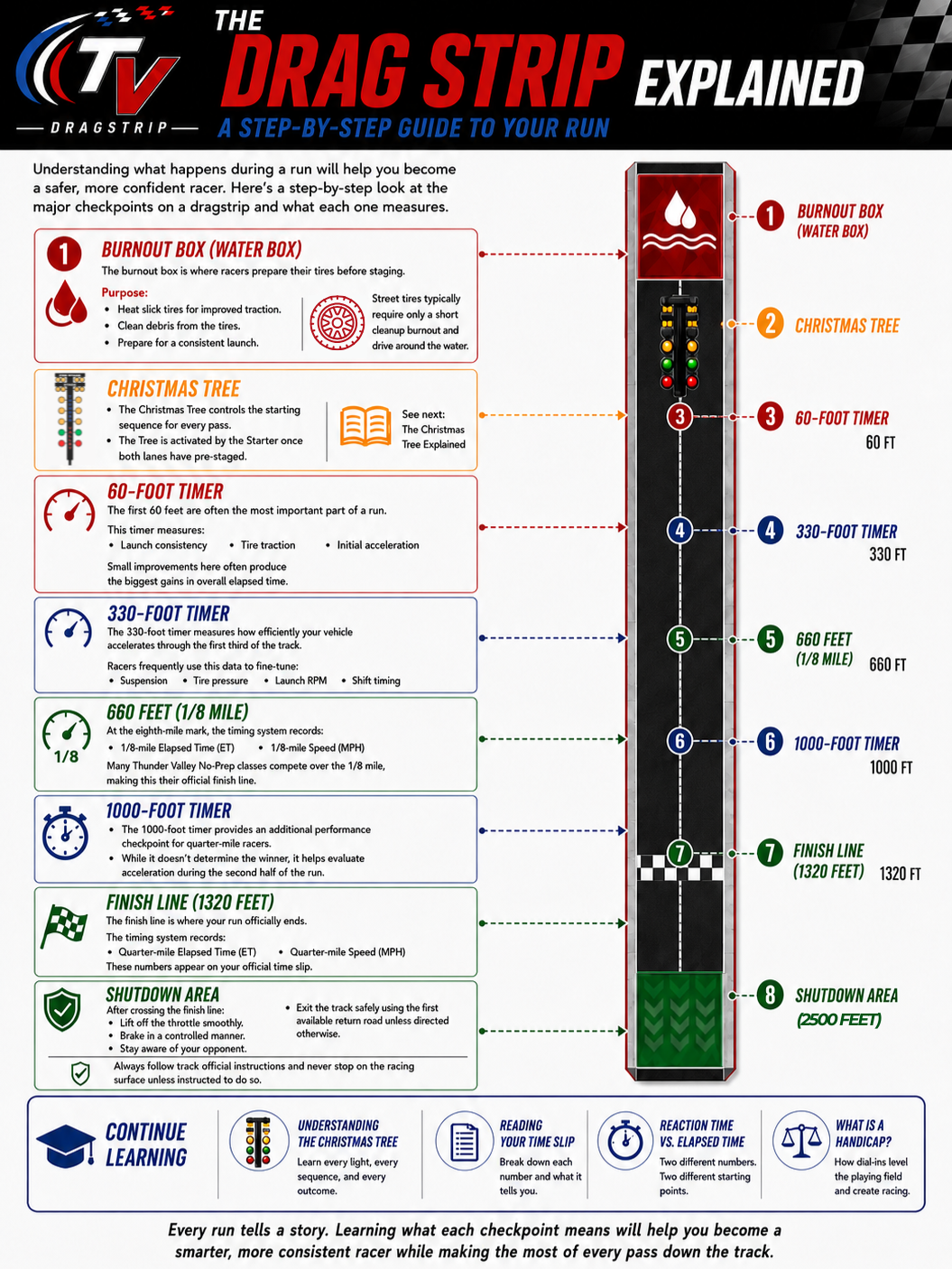
The Drag Strip Explained
-
The burnout box is where racers prepare their tires before staging.
Purpose:
Heat slick tires for improved traction.
Clean debris from the tires.
Prepare for a consistent launch.
Street tires typically require only a short cleanup burnout and drive around the water.
-
The Christmas Tree controls the starting sequence for every race.
The Tree is activated by the Starter once both lanes have pre-staged.
The Christmas Tree Explained
-
The first 60 feet are often the most important part of a run.
This timer measures:
Launch consistency
Tire traction
Initial acceleration
Small improvements here often produce the biggest gains in overall elapsed time.
-
The 330-foot timer measures how efficiently your vehicle accelerates through the first third of the track.
Racers frequently use this data to fine-tune:
Suspension
Tire pressure
Launch RPM
Shift timing
-
At the eighth-mile mark, the timing system records:
1/8-mile Elapsed Time (ET)
1/8-mile Speed (MPH)
Many Thunder Valley No-Prep & Junior classes compete over the 1/8 mile, making this their official finish line.
-
The 1000-foot timer provides an additional performance checkpoint for quarter-mile racers.
While it doesn't determine the winner, it helps evaluate acceleration during the second half of the run.
-
1320 Feet
The finish line is where your run officially ends.
The timing system records:
Quarter-mile Elapsed Time (ET)
Quarter-mile Speed (MPH)
These numbers appear on your official time slip.
While elapsed time measures how quickly you completed the run, trap speed is a strong indicator of your vehicle's horsepower and overall performance.
Cars with similar ETs can have very different trap speeds depending on power, weight, traction, and driving style.
-
After crossing the finish line:
Lift off the throttle smoothly.
Brake in a controlled manner.
Stay aware of your opponent - left lane has the right-of-way.
Exit the track safely using the first available return road unless directed otherwise.
Always follow track official instructions and never stop on the racing surface unless instructed to do so.
The Christmas Tree Explained
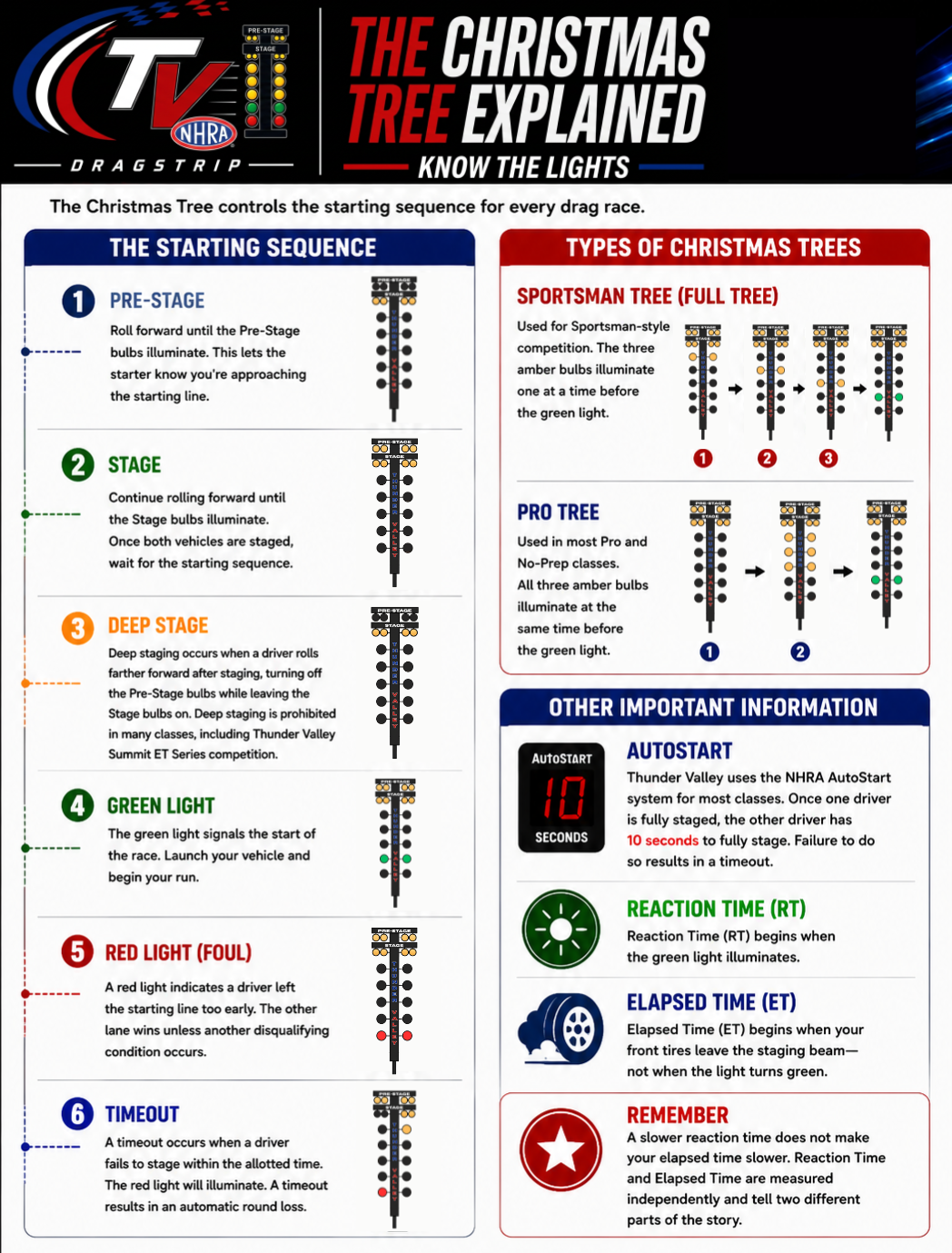
Understanding the Starting Sequence
-
Roll forward - slowly - until the Pre-Stage bulbs illuminate. This lets the starter know you're approaching the starting line.
-
Continue rolling forward - slowly - until the Stage bulbs illuminate.
Once both vehicles are staged, wait for the starting sequence.
-
Deep staging occurs when a driver rolls farther forward after staging, turning off the Pre-Stage bulbs while leaving the Stage bulbs on. Deep staging is prohibited in many classes, including Thunder Valley Summit ET Series competition.
-
The green light signals the start of the race. Launch your vehicle and begin your run.
-
A red light indicates a driver left the starting line too early. The other lane wins unless another disqualifying condition occurs.
-
A timeout occurs when a driver fails to stage within the allotted time. The red light will illuminate. A timeout results in an automatic round loss.
-
Sportsman Tree (Full Tree)
Used for Sportsman-style competition. The three amber bulbs illuminate one at a time before the green light.
Pro Tree
Used in most Pro and No-Prep classes. All three amber bulbs illuminate at the same time before the green light.
-
AutoStart
Thunder Valley uses the NHRA AutoStart system for most classes. Once one driver is fully staged, the other driver has 10 seconds to fully stage. Failure to do so results in a timeout.
Please note:
Reaction Time (RT) begins when the green light illuminates.
Elapsed Time (ET) begins when your front tires leave the staging beam—not when the light turns green.
Remember: A slower reaction time does not make your elapsed time slower. Reaction Time and Elapsed Time are measured independently and tell two different parts of the story.
Understanding Your Time Slip
-
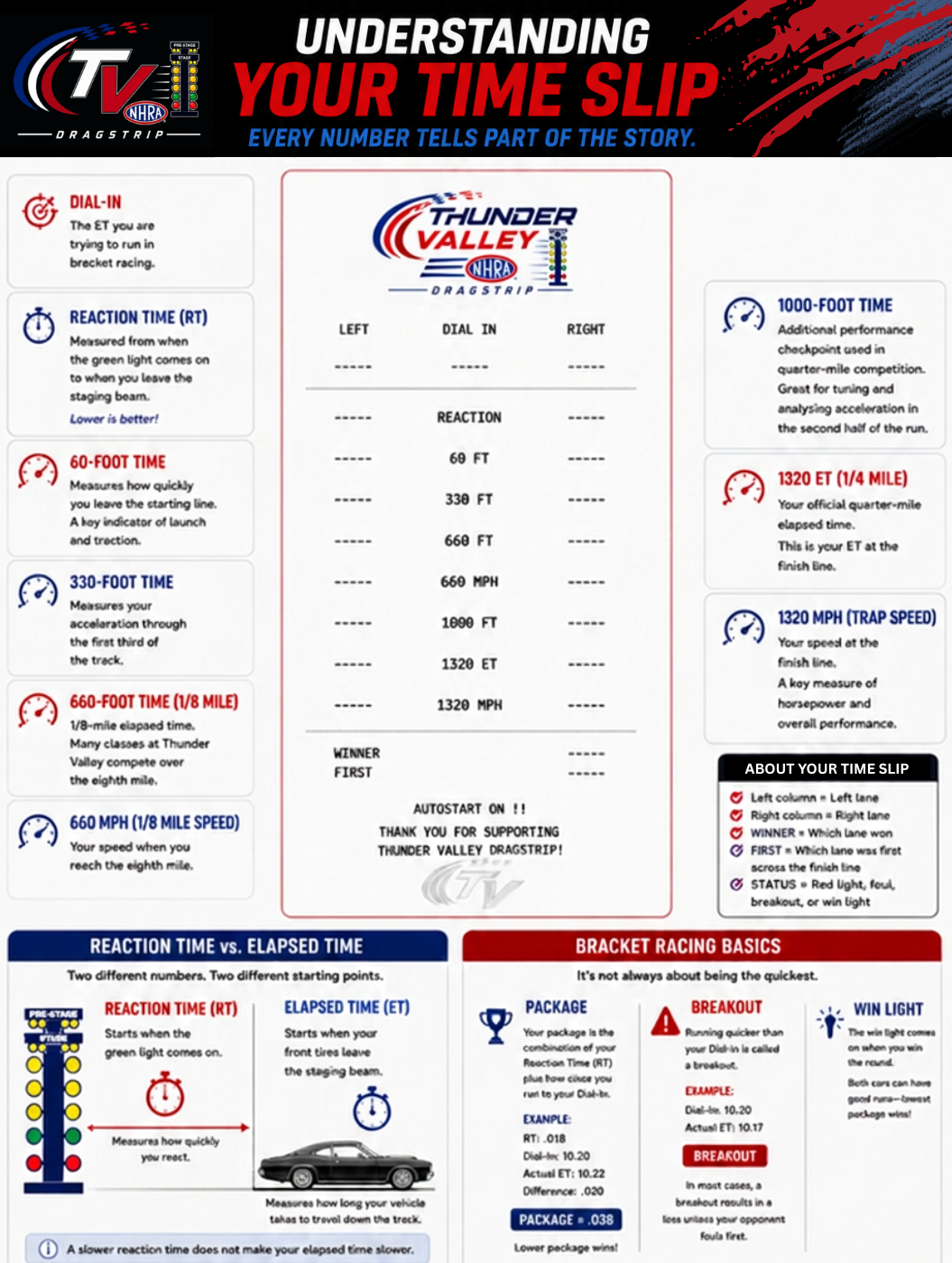
Every run down the dragstrip generates a time slip—a complete record of your performance from the starting line to the finish line. Each number tells a specific part of the story.
Learning to read your time slip will help you:
Improve consistency
Identify strengths and weaknesses
Better tune your vehicle
Make smarter decisions between rounds
Become a more competitive racer
-
Your Dial-In is the elapsed time (ET) you predict your vehicle will run during bracket racing.
The goal isn't always to run the quickest pass—it's to run as close to your dial-in as possible without running quicker (breaking out).
-
Reaction Time measures how quickly you react to the green light.
It begins the instant the green light illuminates and ends when your front tires leave the staging beam.
A quicker reaction time gives you an advantage at the starting line, but it does not affect your elapsed time (ET).
Remember:
Lower is better.
A slower RT doesn't make your car slower—it simply means you started later.
Pro tip: Leave on the third amber!
-
This is your official elapsed time at the finish line.
Elapsed Time begins when your front tires leave the staging beam—not when the light turns green.
Your ET reflects how long your vehicle took to travel the length of the track..
-
INear the bottom of the time slip you'll see information showing the outcome of the race.
Winner identifies the lane that won.
First indicates which vehicle crossed the finish line first.
Status may indicate a win , red light (foul), breakout, timeout, buyback, or other race result.
-
IOne of the most common misconceptions in drag racing is that a slower reaction time makes your elapsed time slower.
It doesn't.
These two numbers measure completely different things:
Reaction Time (RT): How quickly you reacted to the green light.
Elapsed Time (ET): How long your vehicle took to travel from the starting line to the finish line.
Because ET doesn't begin until your vehicle leaves the staging beam, you can have a poor reaction time and still run your quickest ET of the day.
-
Bracket racing (handicap racing) rewards consistency—not necessarily the fastest vehicle.
Three terms you'll hear often are:
Package
Your package combines your reaction time with how close you ran to your dial-in. Lower packages are better.Breakout
Running quicker than your dial-in is called a breakout and usually results in a loss unless your opponent also fouls or breaks out by a larger margin.Win Light
The win light goes to the driver who reaches the finish line first under the rules of bracket racing. The quickest car doesn't always win—the most consistent driver usually does.
A Day at the Races: What to Expect
Racer Reg & Tech Inspection
-
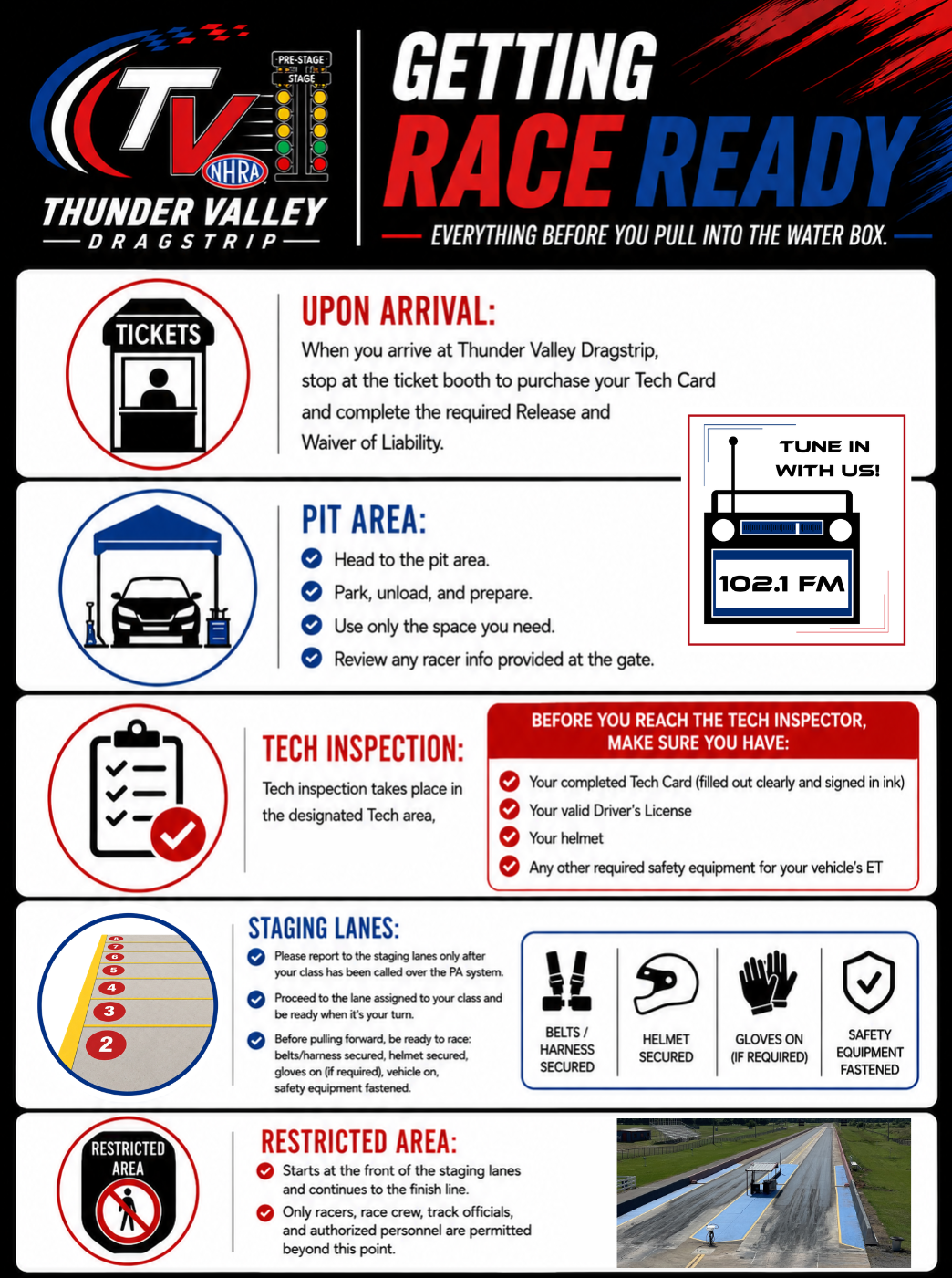
When you arrive at Thunder Valley Dragstrip, stop at the ticket booth to:
Purchase your Tech Card
Complete the required Release & Waiver of Liability
Once you've completed both, you're ready to head into the pit area.
-
After entering the facility:
Park in the pit area
Unload and prepare your vehicle
Please use only the space you need
Take a few minutes to review any racer information provided at the gate
When you're ready, head toward the designated area for Tech Inspection.
-
Tech Inspection takes place in the designated Tech Area.
Before you reach the Tech Inspector, have the following ready:
Completed Tech Card (filled out clearly and signed in ink)
Valid Driver's License
Helmet
Any required NHRA safety equipment for your vehicle's elapsed time (ET)
-
Report to the staging lanes only after your class has been called over the PA system. Tune your FM radio to 102.1 to hear the announcer.
Proceed to your assigned lane and be ready when it's your turn.
Before pulling forward, make sure:
Seat belt or harness is secured
Helmet is fastened
Gloves are on (if required)
Vehicle is running
All required safety equipment is properly secured
Being fully prepared helps keep race day safe and on schedule.
-
The Restricted Area begins at the front of the staging lanes and extends all the way to the finish line.
Only the following individuals are permitted beyond this point:
Racers
Race crew
Track officials
Authorized media personnel
For everyone's safety, spectators are not permitted in the restricted area.
Race Procedures
-
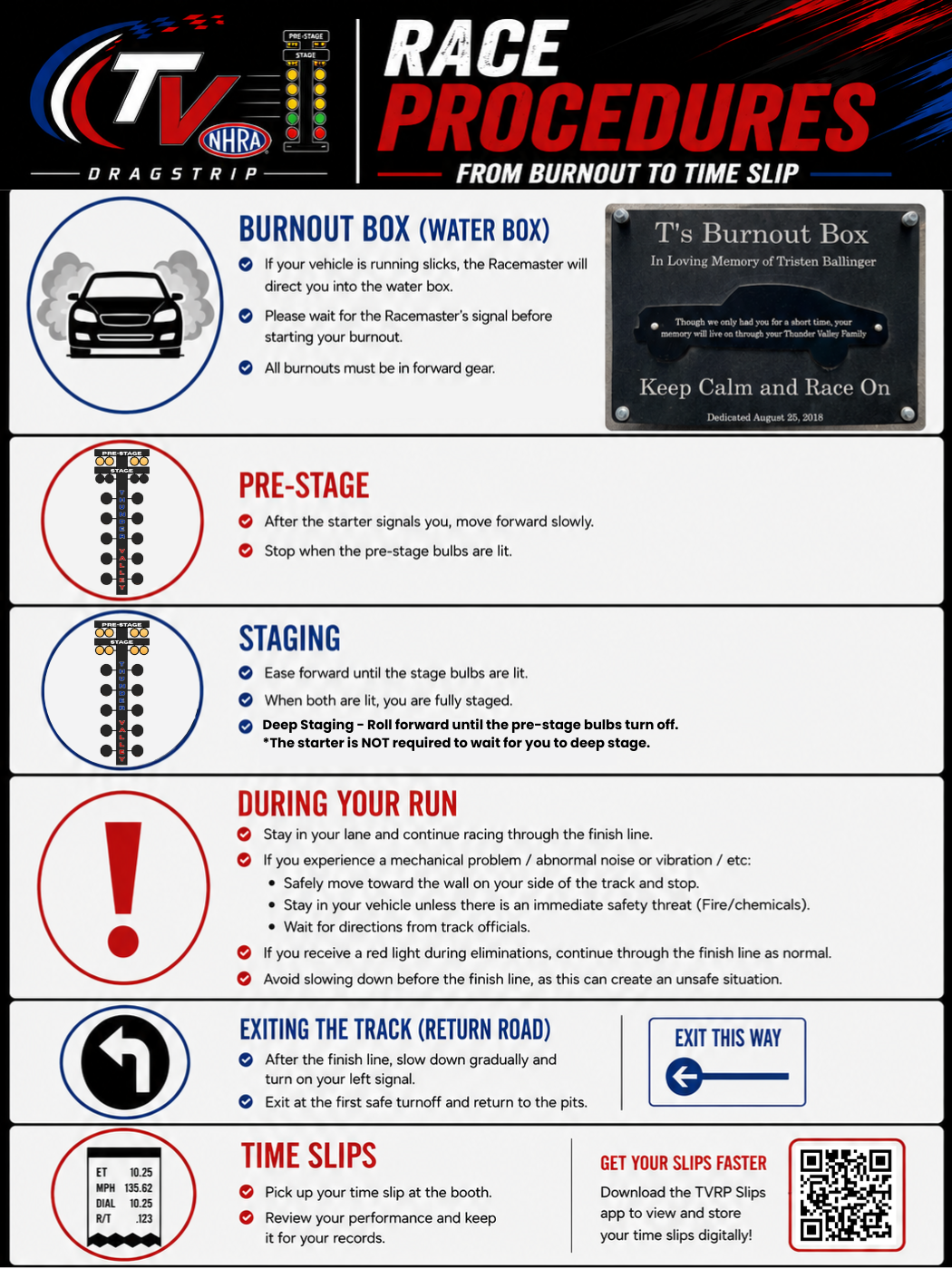
If your vehicle is equipped with slick tires, the Racemaster will direct you into the water box.
Before beginning your burnout:
Wait for the Racemaster's signal.
Perform all burnouts in a forward gear only.
If you're unsure where to stop, ask a track official for assistance.
-
When signaled by the starter, slowly move forward until the Pre-Stage bulbs (the top two small bulbs on the Christmas Tree) illuminate.
Once pre-staged:
Stop and wait for your opponent to pre-stage.
Do not continue forward until you're ready to stage.
-
When both drivers are ready, slowly move forward until the Stage bulbs illuminate.
Once both vehicles are fully staged:
The starting sequence will begin automatically.
Stay focused and be prepared for the tree to activate.
Do not back out after staging unless instructed by a track official.
-
If you're planning to deep stage:
Roll forward until the Pre-Stage bulbs turn off and only the Stage bulbs remain illuminated.
Enter the beams in one smooth, continuous motion.
You must be fully staged before your opponent stages.
The starter will not delay the race while waiting for a driver to deep stage.
*Not all classes allow Deep Staging
-
Stay in your lane and continue racing through the finish line.
If you experience a mechanical problem / abnormal noise or vibration / etc:
Safely move toward the wall on your side of the track and stop.
Stay in your vehicle unless there is an immediate safety threat (Fire/chemicals).
Follow directions from track officials.
If you receive a red light during eliminations, continue through the finish line as normal.
Avoid slowing down before the finish line, as this can create an unsafe situation.
-
After crossing the finish line:
Slow down gradually.
Exit at the first safe left-hand turnoff.
Yield to the vehicle in the left lane.
For your safety:
Keep your helmet on until you've exited the racing surface.
Leave your windows up until safely off the track.
Follow all instructions from track officials.
-
The race may be over, but safety remains the priority.
The speed limit on the return road is 15 MPH.
Drive carefully back to the pits.
Stop at the Time Slip Booth to collect your time slip.
If your time slip is missing or appears incorrect, please contact the Race Director or Timing Tower.
-
Get the free TVRP Slips app for timeslips right on your phone.
Junior Racing Programs
Click or tap to expandJr. Drag Racing League
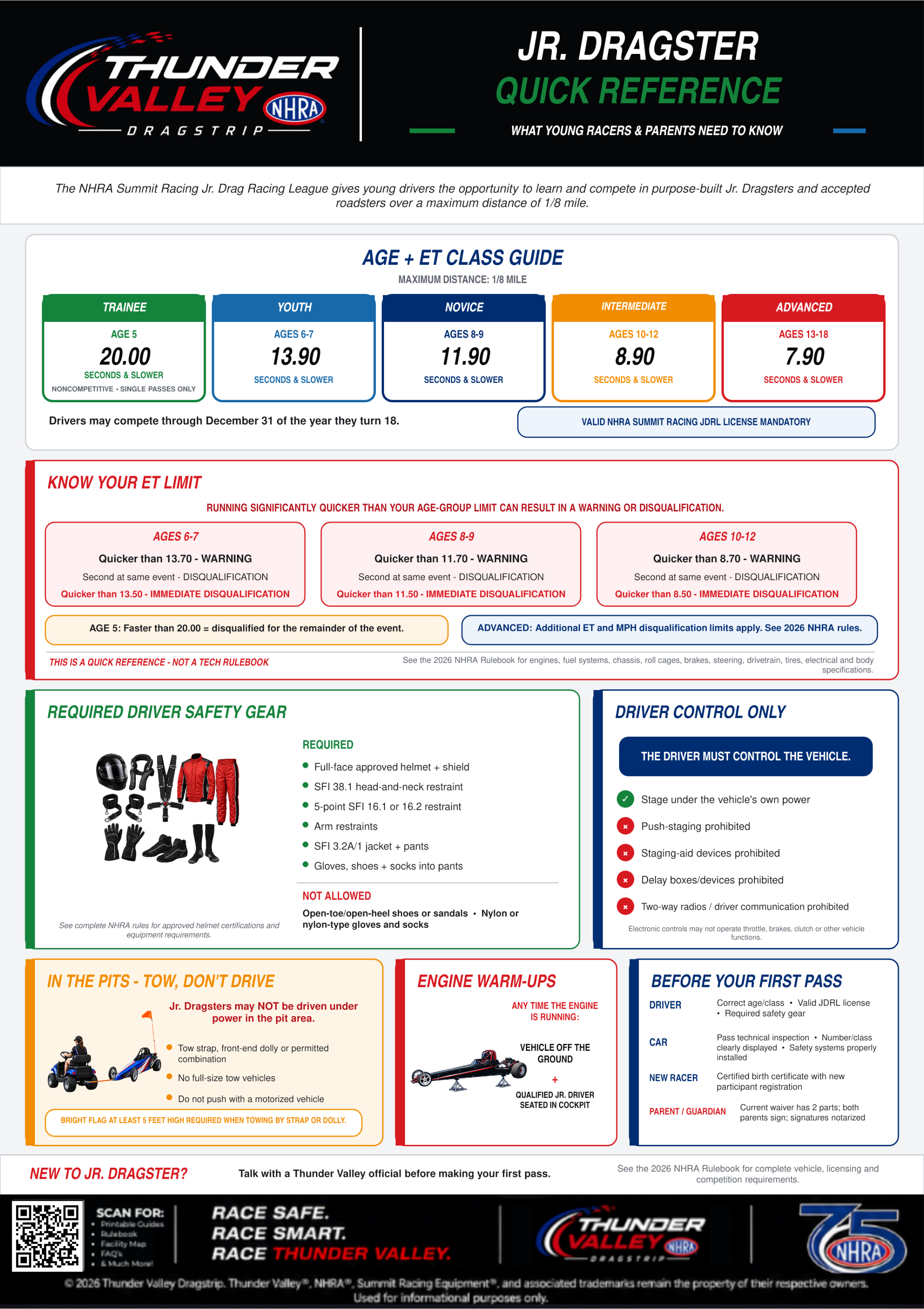
The NHRA Summit Racing Jr. Drag Racing League introduces young drivers to drag racing in purpose-built Jr. Dragsters and accepted roadsters, with noncompetitive participation beginning at age 5 and head-to-head competition beginning at age 6. Racing is conducted over a maximum of 1/8 mile using age-based ET limits designed to help young racers develop their skills safely as they advance through the program. Tap or click the button to learn more.
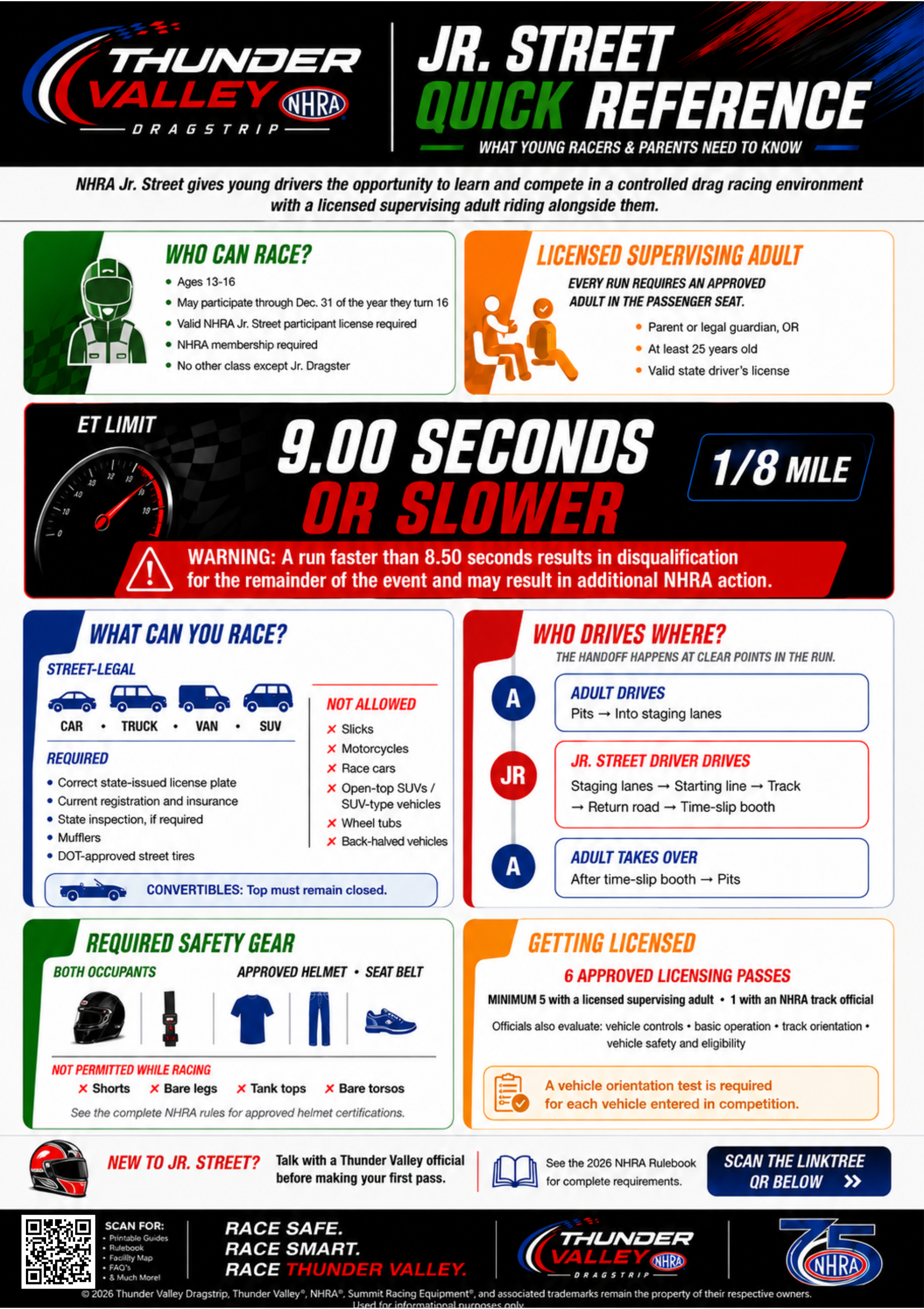
Click or tap to expandNHRA Jr. Street gives drivers ages 13–16 the opportunity to learn and compete in a controlled drag racing environment using street-legal vehicles, with an approved licensed supervising adult riding alongside them. It’s designed to introduce young racers to safe vehicle operation, track procedures, and heads-up competition before they move into other forms of drag racing. Jr. Street runs during Summit ET series races. Tap or click the button to learn more.
Jr. Street Class
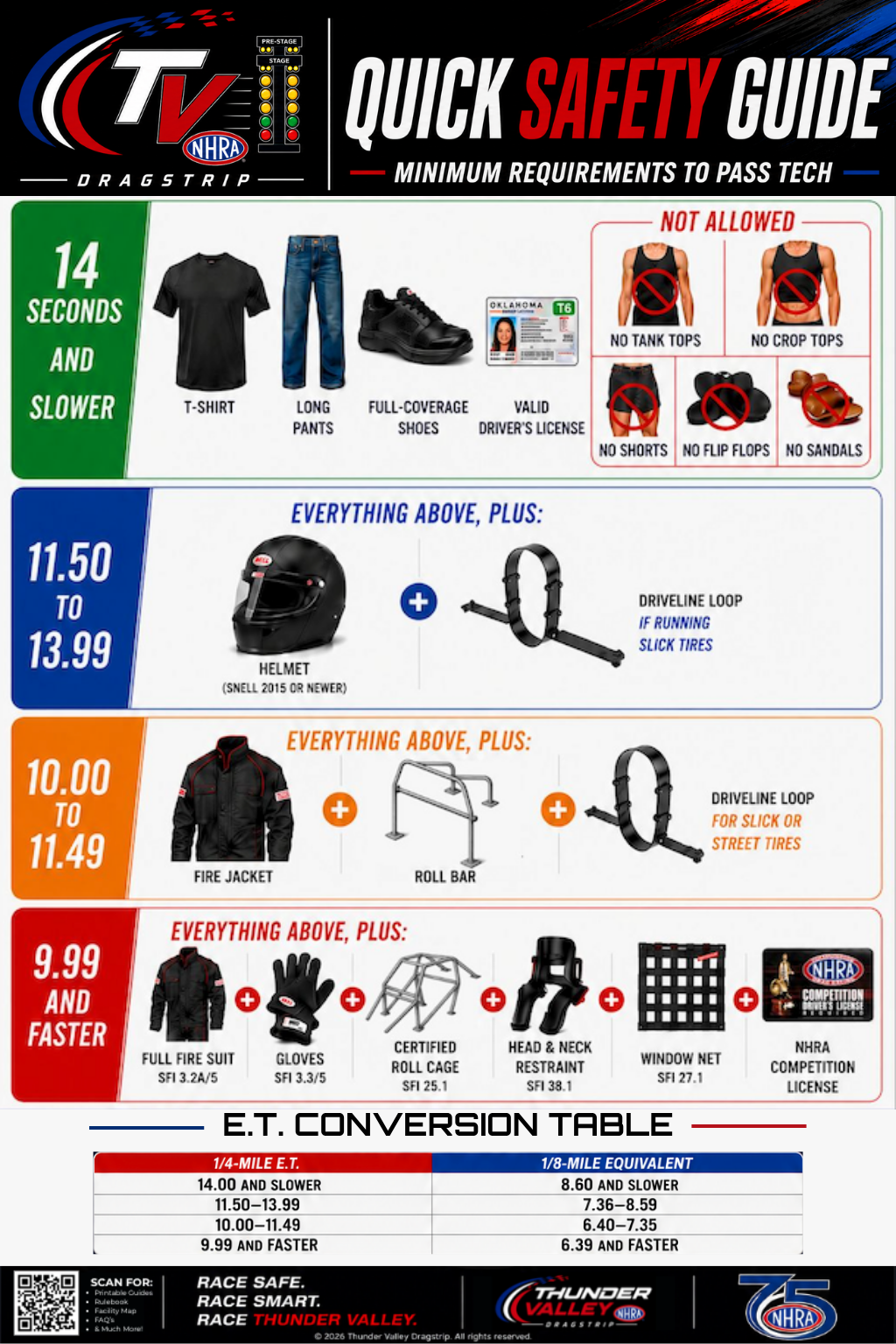
Safety specs
At-a-glance
OFFICIAL NHRA RULEBOOK
Click or tap the rulebook to view or download a digital copy.